

ForceFold: Improving Protein–Peptide Complex Prediction Through Physics-Guided Co-Folding
Why protein–peptide complexes are hard to predict
Peptides are flexible. A short chain can adopt many backbone and side-chain conformations, and the bound state is only one of them — so the model has to find a specific geometry in a large conformational space. The receptor is not static either: binding sites can shift, loops can reorder, and the pocket that accepts the peptide may differ from the one seen in an apo structure.
Pure docking samples physical poses but has no learned prior over the folded complex. End-to-end co-folding has that prior but can miss binding modes that depend on receptor motion or on contacts it was never conditioned on. On flexible peptide systems, either approach alone leaves accuracy on the table.
ForceFold combines the two: a physical search proposes candidate binding modes, and a co-folding model, conditioned on that physical evidence, resolves them into a single complex.
How ForceFold works
A physics-based complex generator proposes candidate binding modes — conformational sampling and docking with the proprietary ArtiDock-P model — and physics-conditioning adaptors feed that evidence directly into the co-folding model, which resolves and scores the final complex.

Target protein
(structure or sequence)
Candidate peptide
(sequence + topology)
- linear, cyclic & constrained peptides
- NCAAs
- novel peptide scaffolds
- novel targets & pockets
Conformational sampling of protein and ligand + docking (ArtiDock-P)
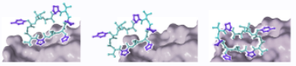 ~ 1M poses
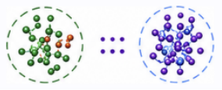
Remove clashing poses, cluster by interface geometry
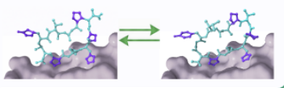
Minimization, scoring
Highlight residue roles / hotspots
Condition pair attention on interface contacts
Coordinate denoising with physics constraints
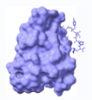
- Energy-based score
- Empirical interaction score
- Co-folding confidence
What was tested
| Dataset | BMI-200, curated subset |
| Size | 172 complexes across 120 receptor targets |
| Configurations compared | Unconditioned co-folding (Boltz-2) · Physical search · Native-restraint conditioning · ForceFold |
| Primary metric | CAPRI Acceptable-or-better, Top-1 — the single highest-ranked structure is close enough to the experimental one to count as the correct binding mode |
| Secondary metric | CAPRI Medium-or-better |
| Verification | Predicted structures compared with experimental structures |
The set starts from 202 complexes; 24 antibody / designed-binder cases and 6 MHC cases are removed, leaving 172. All configurations are evaluated on the same complexes with matched random seeds, so the differences reflect the method, not the sample.
ForceFold vs. alternative configurations
Four configurations, the same 172 complexes, matched random seeds — so the differences come from the method rather than from the sample.
- 50.6% Top-1 accuracy at the CAPRI Medium-or-better threshold across 172 protein–peptide complexes spanning 120 targets.
- 74.4% Top-1 at the CAPRI Acceptable-or-better threshold on the same benchmark — 17.6 percentage points over unconditioned Boltz-2 (56.8%) and 8.1 points over native-restraint conditioning (66.3%).
- The gain is largest where prediction is hardest: on linear peptides ForceFold reaches 65.7% against 52.8% for native-restraint conditioning, a 12.9-point gain; on macrocycles the two are 80.7% and 76.0%.
- Spearman ρ = 0.524 for relative peptide-affinity ranking with Receptor.AI's scoring function, vs. 0.432 for Prime MM-GBSA and 0.322 for Glide SP (191 peptides across 10 series).
Top-1 accuracy by configuration
Relative peptide-affinity ranking
Higher Spearman ρ means closer agreement with measured relative affinity. Values are means over the ten series, ± the standard error between series. Those intervals overlap, so this benchmark does not establish a strict ordering of the three methods; the per-series results are in the white paper.
Where the gain comes from
Linear peptides sample more conformations than macrocycles and are the harder case — their accuracy is lower for both methods. That is also where conditioning on the physical search helps most: it recovers almost three times as much accuracy there as on macrocycles.
The correct binding mode is almost always found
The first two values are retrospective ceilings: a qualifying binding mode was available, not necessarily chosen. Read together, they locate the remaining work. The physical search already supplies a correct mode in 95.3% of cases, so the 20.9 points between that and the final answer are a target for the downstream stages — how that evidence is represented, rebuilt and resolved into one answer — rather than for the search itself. (Medium-or-better: 84.1% → 75.0% → 50.6%.)
95% confidence intervals for the ForceFold advantage over native-restraint conditioning: 3.3–12.8 points at Acceptable-or-better, 1.0–10.1 points at Medium-or-better.
What this means in practice
ForceFold returns one answer — the single highest-ranked complex, physically grounded and usable for optimization when no experimental structure exists. On this benchmark that answer reproduces the experimental binding mode in 74.4% of cases. Relative affinity scoring then prioritizes related candidates within that mode for synthesis and testing.
Limitations
- Accuracy depends on receptor preparation and on which conformations are sampled; assembly, protonation and metal coordination all propagate downstream.
- Generating an acceptable binding mode does not guarantee selecting it — representation and final ranking remain error sources.
- Results are on the BMI-200-derived set and do not establish superiority over every available tool; broader prospective evaluation is still needed.
- The comparison with native restraints feeds the same physical evidence to the same co-folding model through a different interface, so it measures the conditioning route, not one isolated encoding variable.
Method in Sections 2.3 and 3.3 of the Receptor.AI Peptide Discovery Platform white paper; this benchmark in Sections 4.2–4.3.
Read the white paper →
Have a peptide target without a solved complex?
We can predict the binding mode for your target and hand the top-ranked complex straight to optimization.


