

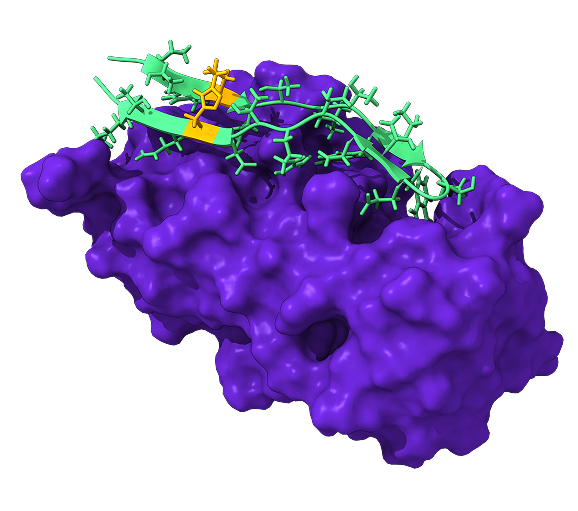
9/24
peptides with KD ~100nM
~10x
affinity improvement
97 nM
best affinity
01/ Background
- The target is a protein from interleukin family.
- Indication is an inflammatory disease.
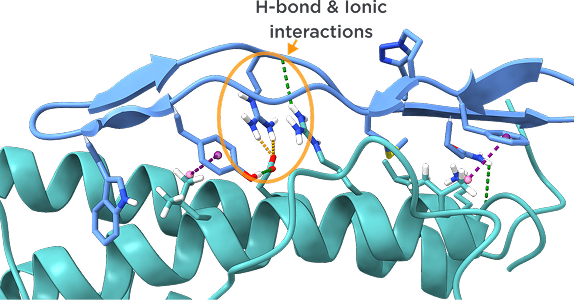
- Starting point:hard-to-drug: large and highly charged.stabilized by the organic linker, with a relatively weak binder affinity (1 µM).
- Key interactions for the starting peptide were:
- hydrogen bonds with ASP, ARG and backbone;
- hydrophobic interactions with LEU;
- ionic bond with ASP.
- Main challenges are:
- Main challenges are:
- no SAR;
- no co-crystal structure available.
- The goal is to increase affinity.
02/ Methodology
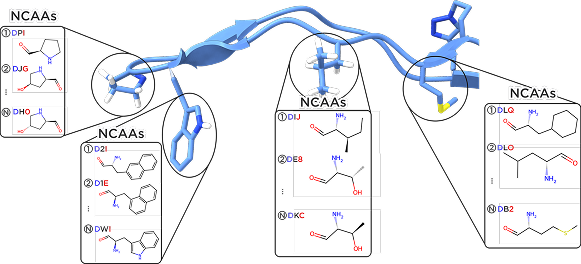
- We modeled peptide-protein complex and used AI-guided optimization with position-specific mutation alphabets (including non-canonical AAs)
- 100K sequences were screened.
- 24 peptides were synthesised and tested.
04/ Results
- Affinity improved:
- 9/24 peptides have affinity of ~100 nM.
- best affinity of 97 nM achieved.
- ~10x affinity improvement overall (1 µM → ~100 nM).
- Key interactions for the best optimized peptide were:
- hydrogen bonds with ASP, ARG and backbone;
- many hydrophobic interactions with LEU and HIS;
- ionic bond with ASP;
- intrapeptide PI-cation stacking.
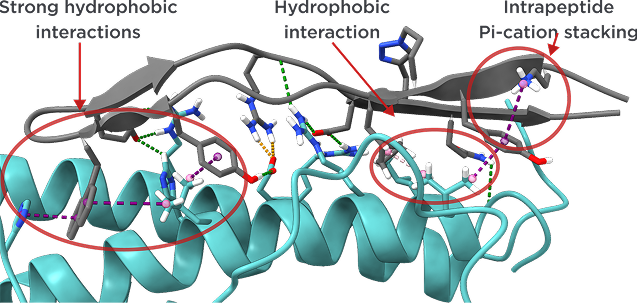
Optimized peptide with key interactions


