

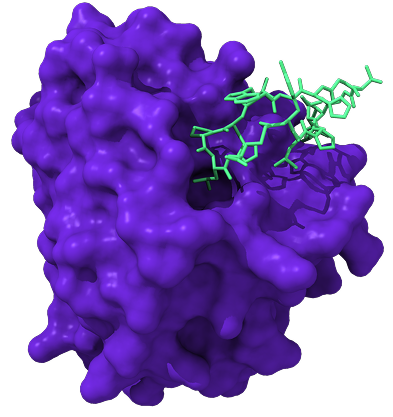
16 AA
peptide optimized
-5.92
PAMPA logPerm achieved
250 nM
IC50 of the best peptide
01/ Background
- The target is Vps29 that plays a key role in endosomal recycling through intracellular PPI.
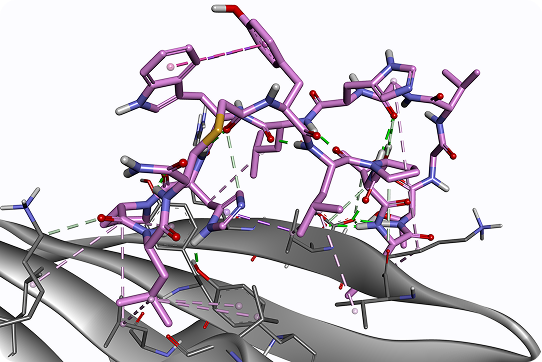
- Starting peptide of 16 AAs had low experimental permeability (-8 logPerm) and affinity (780 nM)
- Starting binding mode derived from the co crystal structure, stabilized by 6 hydrogen bonds with Glu, Val, and Tyr residues.
- The ligand also forms 11 hydrophobic interactions with Lys, Arg, Leu, and Tyr.
- The goal is to achieve membrane permeability and to improve affinity.
02/ Methodology
- We defined the list of allowed AA substitutions per position, resulting in the design space of >1B peptide sequences.
- 100k compounds were screened with QuorumMap.
- 20 top-ranked peptides from each strategy were selected for experimental testing.
03/ Results
- 9 hits improved both affinity and permeability:
- affinity improved from 780 nM to ~250 nM;
- permeability improved from −8 to −5.92 (logPerm).
- A new π-π interaction is formed in the optimized binding mode between Tyr and Pro, adding aromatic stabilization in cost of few weak hydrophobic interactions.
- The number of hydrogen bonds in optimized binding mode increased to 8: with Glu, Arg, and Tyr.
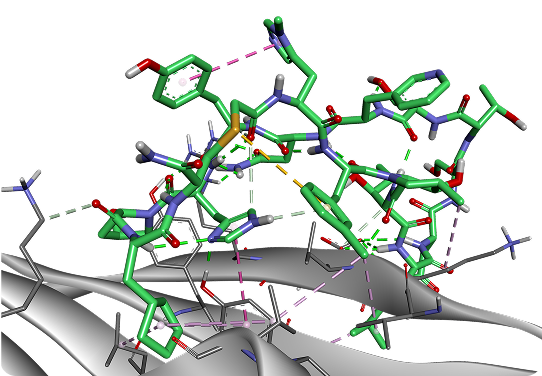
Optimized binding modes
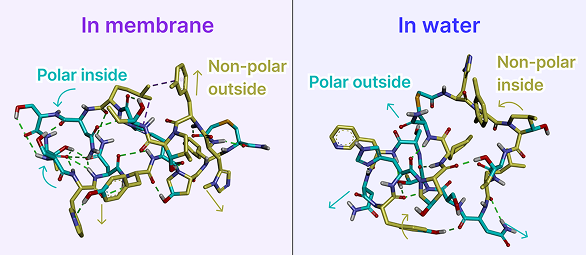
04/ Conformational flexibility
- The starting peptide showed identical in-membrane and in-water conformations.
- The optimized peptide showed clear chameleonicity, adapting its conformation to both membrane and water environments.
- In the membrane, hydrophobic residues are exposed to the hydrophobic environment, while hydrophilic residues form a dense network of hydrogen bonds that bury polarity inside the peptide.
- In water, hydrophobic regions become partially shielded, while polar residues form direct interactions with the solvent, reducing the internal hydrogen-bond network.
05/ Second round of optimization
- Allowed N-shielding positions were defined as sites where modification would not disrupt the binding geometry.
- N-shielding included methyl, ethyl, propyl, and cyclopropyl groups..
- The best peptide has ethyl shielding at positions 1, 7, and 9, reaching logPerm of -5.63.10
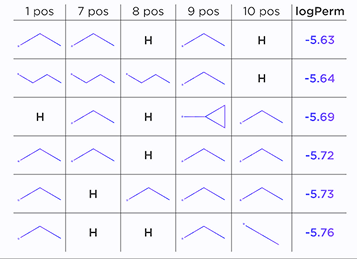
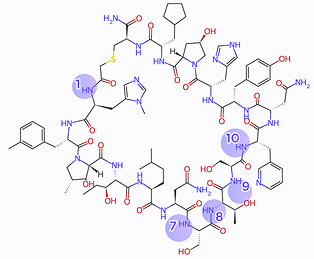
Guided N-shielding positions for improved peptide permeability.


