

From peptide–target complex modeling to candidates prioritized for synthesis and testing
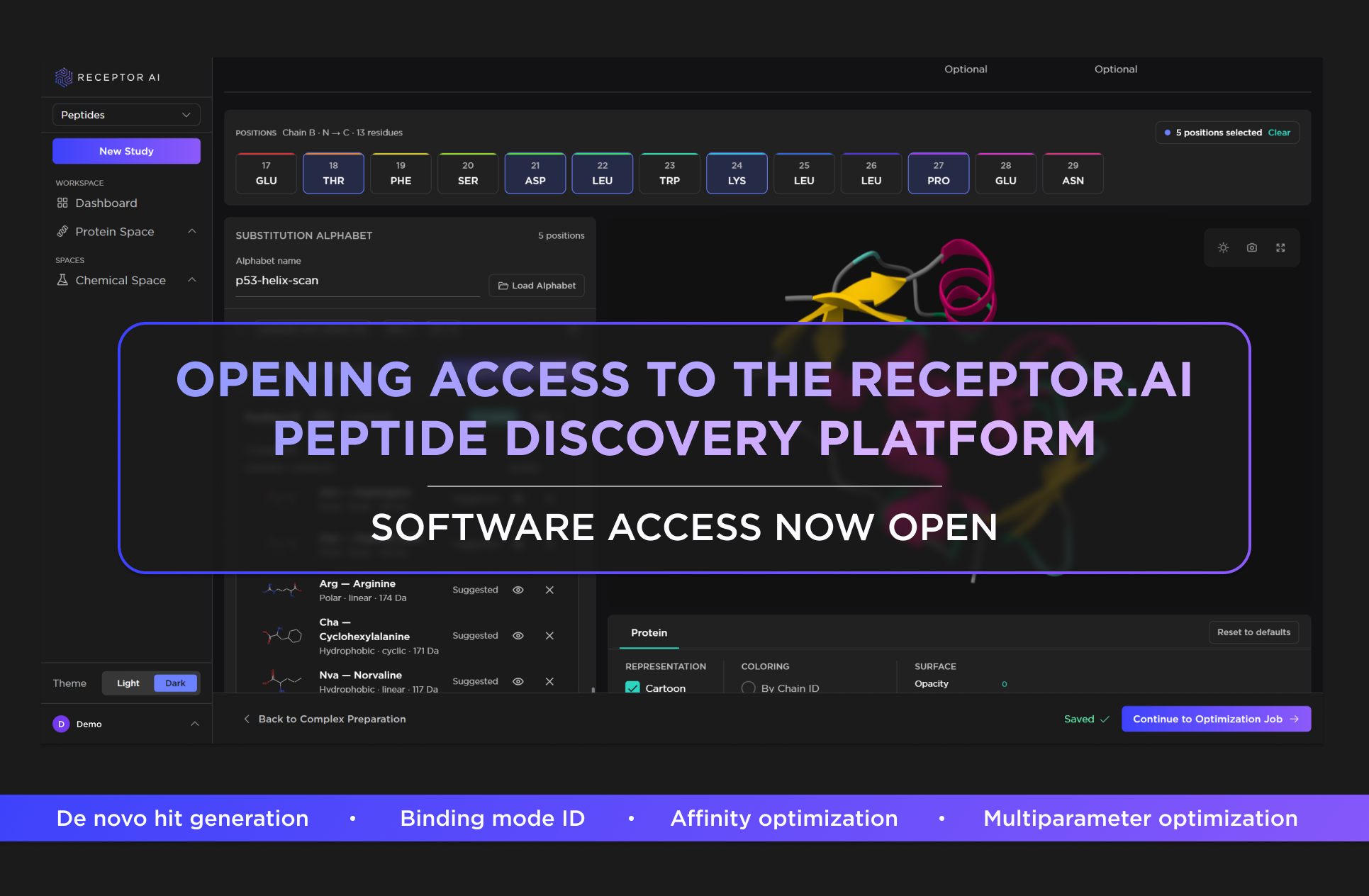
Opening Access to the Receptor.AI Peptide Discovery Platform
From peptide–target complex modeling to candidates prioritized for synthesis and testing
Announcement


Full Text
Experimental screening can identify a target binder, sometimes a strong one, without telling us where it binds or which interactions are responsible. From there, even a single amino-acid substitution may change the peptide’s conformation and alter its binding mode.
Affinity is also rarely the only property that matters. A peptide must meet the physicochemical and developability requirements to become a drug. For intracellular targets and oral delivery, permeability may become as important as binding.
This is where many peptide programs slow down. The team has a promising starting point, but too little structural information to decide which peptide modification to test next.
Peptide chemical space extends far beyond sequences of canonical residues: it includes non-canonical amino acids, backbone modifications and constrained topologies. It cannot be searched experimentally in full.
A useful design system needs to connect structural context with automated chemical space exploration and learn from each experimental round.
That is the idea behind the Receptor.AI End-to-End Peptide Discovery Platform.
Modeling the Peptide–Target Complex
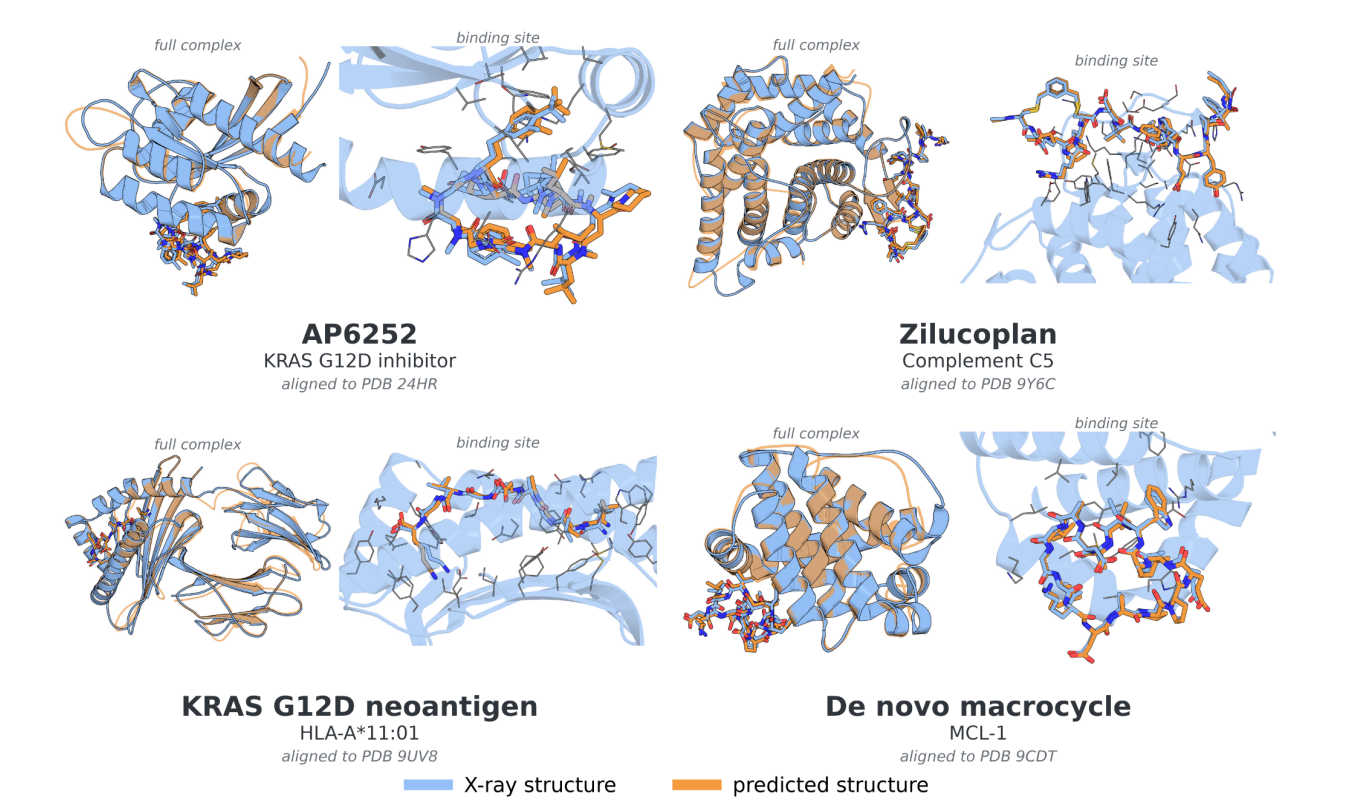
When an experimental peptide hit is available, ForceFold, our infrastructure for peptide–protein complex modeling, first uses physics-based sampling to generate receptor states and peptide conformations. ArtiDock-P then generates candidate docking poses, which are clustered and filtered before the most plausible binding modes proceed to all-atom co-folding and multicomponent scoring.
When no experimental hit is available, the workflow can begin with de novo peptide generation against a structurally defined target region.
Both routes lead to the same practical starting point: a peptide–target complex that can guide the next design step.
Selecting Modifications for Testing
Once a peptide–target complex has been modeled, the platform uses the predicted binding mode to define a project-specific design space. Its auto-configuration workflow identifies the most promising substitutions at each peptide position based on the peptide’s interactions with the target.
These substitutions can include canonical residues and a much broader range of non-canonical chemistry. The platform supports more than 12,000 building blocks, including D-isomers, N-methylated residues, and other backbone modifications.
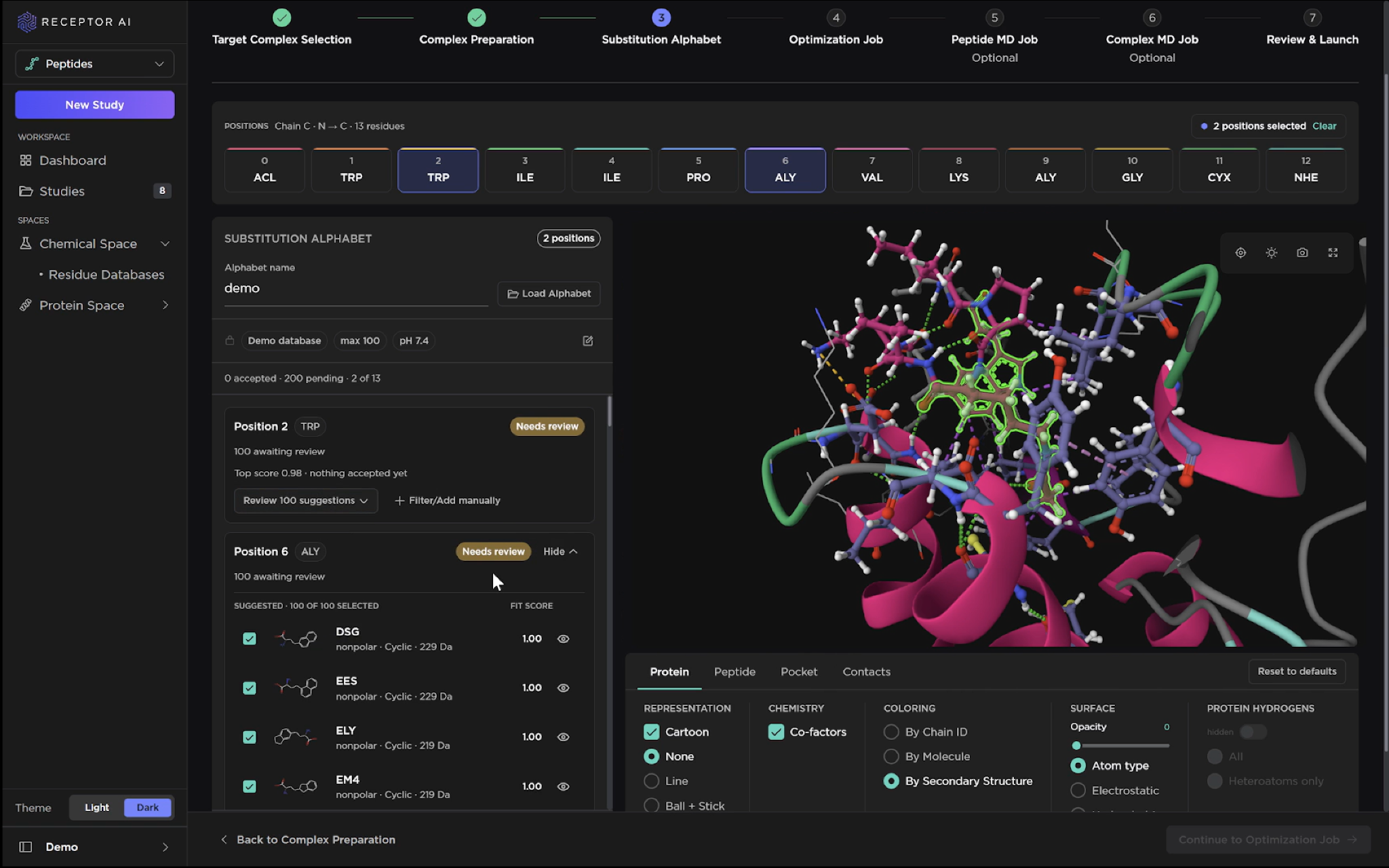
QuorumMap, our optimization engine, then actively searches this defined chemical space. Candidate modifications are evaluated in the context of the modeled complex, including how they may affect peptide conformation and interactions with the target. Rather than passing every candidate through the same fixed sequence of filters, QuorumMap explores the space using lower-cost evaluation methods and selectively advances promising or uncertain candidates to more computationally intensive physics-based calculations.
This framework supports multiparameter optimization: the search can incorporate multiple project-specific objectives, such as passive membrane permeability in addition to affinity, and prioritize candidates according to the required balance of properties.
The most promising peptide designs are selected for synthesis and experimental testing. StratAI, our agentic decision engine, coordinates the broader DMTA workflow, carrying the resulting experimental data into the next design round. The objective is not simply to produce a ranked list, but to support a better-informed next experiment.
What Research Teams Can Access Today
Until October 14, these capabilities were available exclusively through Receptor.AI’s collaborative discovery programs with pharmaceutical and biotechnology partners. We have now introduced direct software access as an additional way for research teams to work with the platform.
The current software release focuses on structure-guided peptide affinity optimization and MPO. Teams can define the positions and substitutions they want to explore, evaluate proposed variants in the peptide–target complex, and prioritize candidates for experimental testing.
The end-to-end platform also supports hit identification, binding-mode modeling, passive membrane permeability assessment and multiparameter design. These capabilities are currently available through collaborative discovery programs and are planned for future software releases.
Benchmarks and Experimental Results
Alongside opening access to the platform, we published a white paper presenting its methodology, component-level benchmarks, and results from experimental peptide programs. Four supporting benchmark datasets are publicly available.
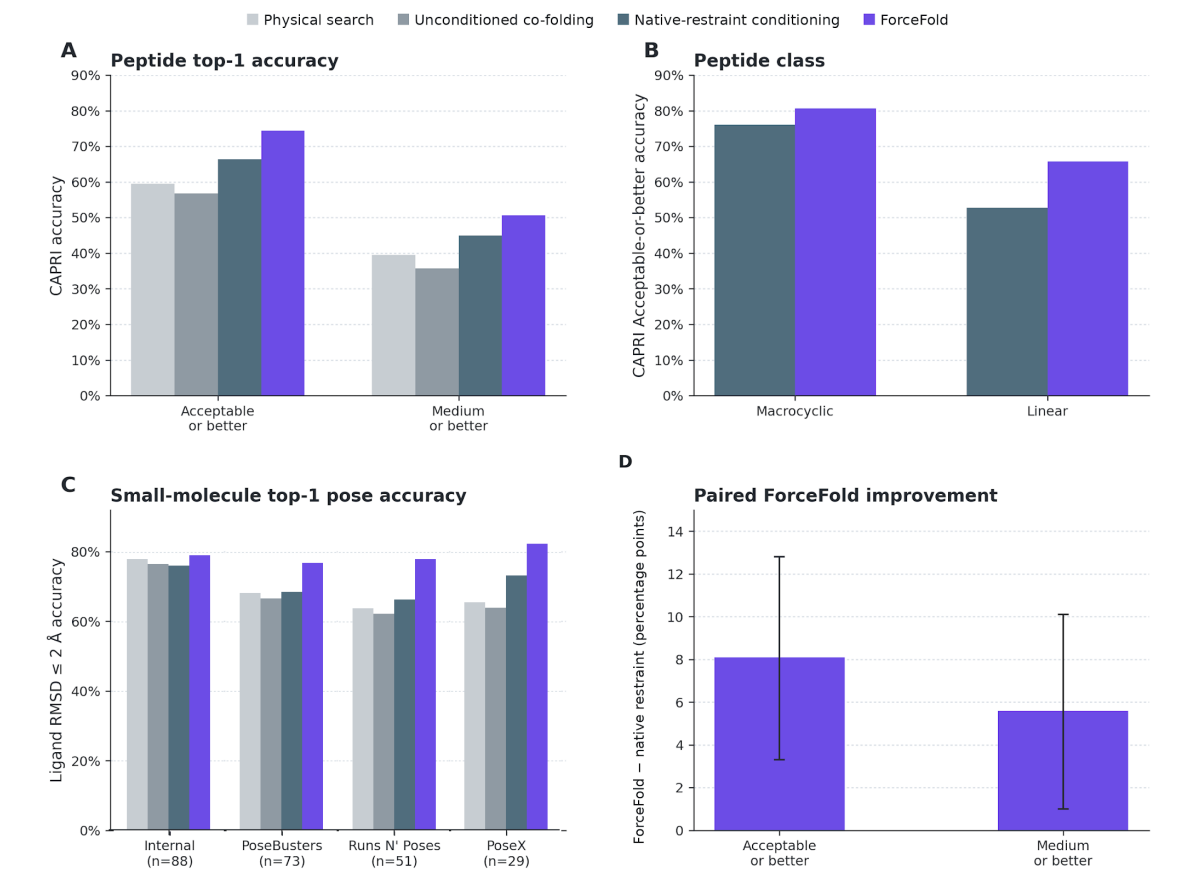
ForceFold achieved CAPRI Acceptable-or-better accuracy for 74.4% of top-ranked predictions across 172 protein–peptide complexes.
In an experimental affinity-optimization program starting from a micromolar peptide, a single computational pass prioritized 24 designs for synthesis. Nine of them achieved affinities below 100 nM.
Webinar Recording and Next Session
Our October webinar examined structure-guided peptide design from binding-mode prediction through candidate prioritization. It also included a live demonstration of the platform.
Watch “Structure-Guided Peptide Design: Receptor.AI Platform”
Our next webinar will focus on one of the hardest properties in peptide design: passive membrane permeability.
On November 18, Prof. Scott Lokey and Dr. Semen Yesylevskyy will discuss the limitations of current permeability assays and ML models, the role of conformational ensembles, and where physics-based modeling can add information.
The session will also cover a 16-residue macrocyclic peptide program in which affinity and permeability were optimized together.
Membrane-permeable peptides: Challenges in passive membrane permeability optimization
November 18, 2026 | 11:00 AM ET
The value of computational peptide design is measured by the decisions it improves. The number of generated candidates matters far less than knowing which peptide to synthesize next, why it was selected and what the resulting experiment should teach us.


