

AI-ACCELERATED DRUG DISCOVERY


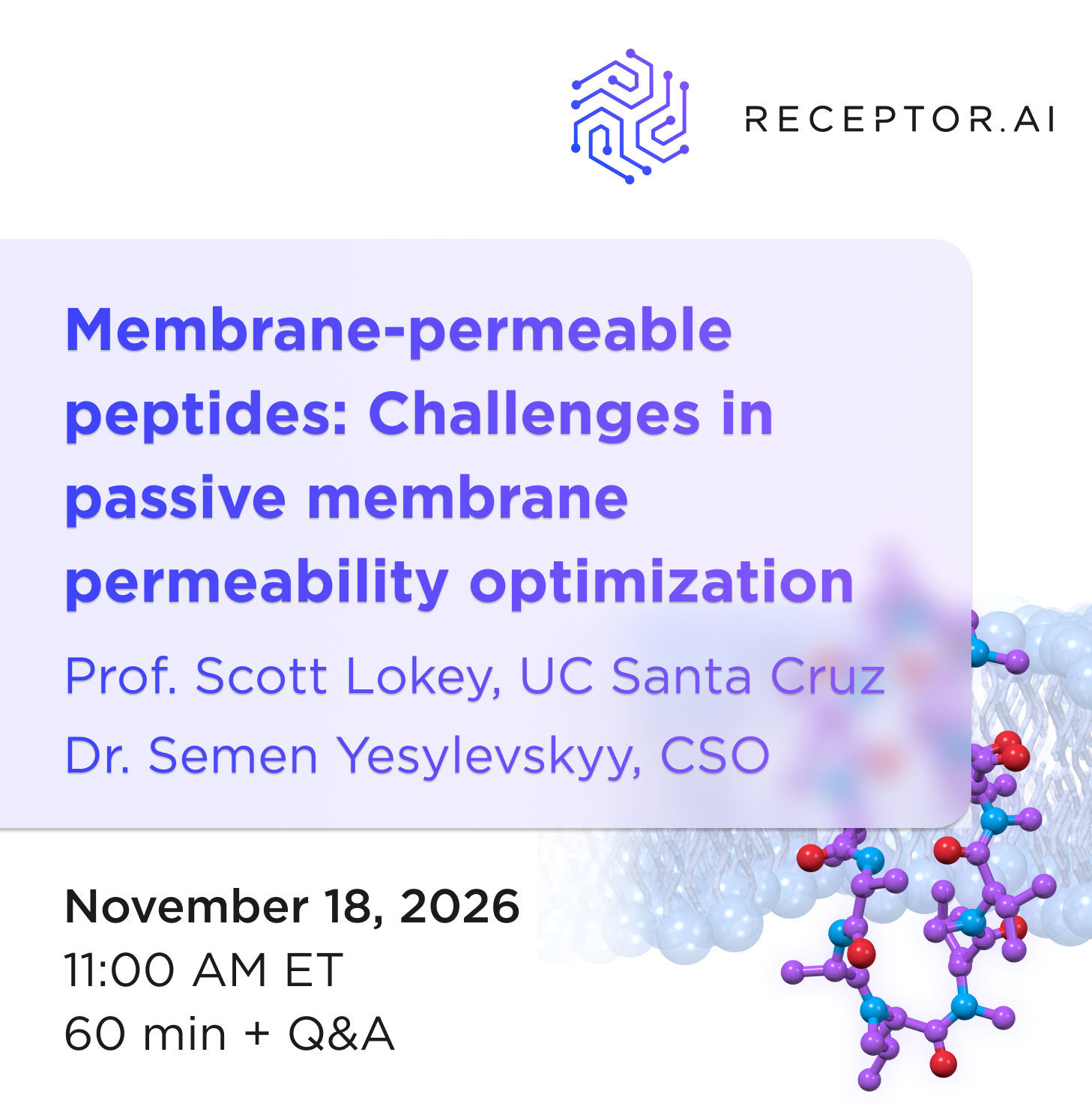
Poor passive membrane permeability remains one of the main barriers to achieving intracellular exposure and oral absorption of peptide therapeutics. Optimizing it is difficult because permeability depends not only on sequence, but also on the conformational ensemble a peptide adopts in aqueous and membrane environments.
Experimental validation presents its own trade-offs. Measurements across well-defined lipid bilayers are difficult to scale for an optimization series, while faster assays such as PAMPA can vary between protocols and laboratories, while the physics of this assay is not well understood. This makes it difficult to compare results and build models that remain accurate outside the data on which they were trained.
These limitations also affect computational prediction. Machine-learning models can perform well within a defined dataset and assay, but their accuracy may decrease for new peptide topologies, compositions, or experimental conditions. Physics-based methods are less dependent on existing permeability data, but require more computation and remain sensitive to the chosen force field, membrane model, and conformational sampling.
Scott Lokey, Professor of Chemistry at UC Santa Cruz and Peptide Discovery Advisor to Receptor.AI, will set out what each class of permeability measurement can and cannot establish, and how the choice of assay affects subsequent modeling and optimization.
Semen Yesylevskyy, CSO and Co-founder of Receptor.AI, will present where predictive models remain valid, the limits of physics-based methods, and Receptor.AI’s combined approach.
The session will also include a real-world peptide optimization case study showing improvements in both passive membrane permeability and target affinity. Open discussion and audience Q&A will also take place.


