

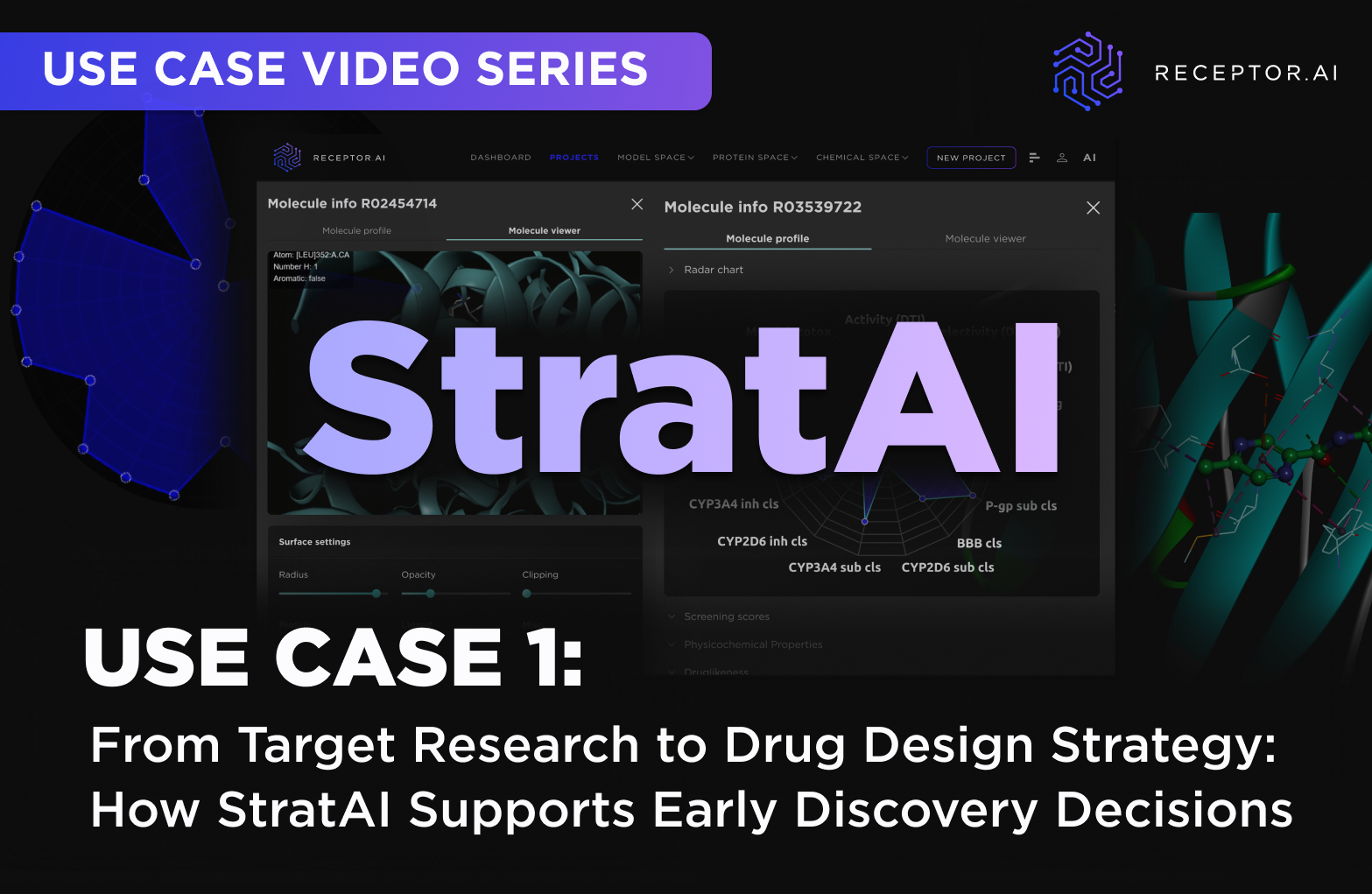
From Target Research to Drug Design Strategy: How StratAI Supports Early Discovery Decisions
Announcement


Full Text
At the beginning of a program, teams may already have several useful signals: published studies, structural data, known ligands, activity results, selectivity concerns, and early molecular property information. When these signals are reviewed independently, it becomes difficult to understand how each piece of evidence should influence the next design decision.
StratAI, our decision engine for drug discovery, is designed to support this decision-making stage. It helps connect target research, structural and homologue analysis, compound evidence, SAR interpretation, and binding mode assessment into an adaptive framework for early drug design.
Through this framework, teams can shape a clearer and more reproducible design strategy early on using several key capabilities:
- Building target intelligence from disease context, literature, structures, compounds, and bioactivity data
- Interpreting protein structures, binding sites, and homologues to identify opportunities and selectivity risks
- Navigating chemical space to explore promising compound directions
- Evaluating compounds across multiple parameters, including potency, ADMET, permeability, solubility, selectivity, and structural fit
- Connecting SAR analysis with docking and binding mode assessment to support structure-guided optimization
By bringing these capabilities into one workflow, StratAI helps teams prioritize the most relevant evidence, define stronger design hypotheses, and move more confidently toward the next stage of optimization.
In the video above, we show an example of how StratAI can be used in practice, including SAR analysis and docking-based binding mode assessment.


